
How to Search Shiawassee County Court Records
Most Shiawassee County court records surface first through the state's online case system. MiCOURT Case Search is the main public portal for participating Michigan trial courts. The Circuit Court, District Court, and Probate Court pages on the county website all point to it. The system reaches civil, traffic, criminal, family, and probate cases, based on the court you pick. It works best when you know the court and the case number.
A quick look at the official Shiawassee County homepage shows how the court offices and the clerk connect under one county umbrella.
From that homepage, the Circuit, District, and Probate pages each link the same statewide search tool. Gather a few details before you start. A full name or a case number speeds any search. Case numbers avoid spelling problems and point straight to one file.
- Identify the court level. Felonies, civil claims over $25,000, divorce, and personal protection matters are Circuit Court. Tickets, misdemeanors, small claims, and landlord-tenant cases are District Court. Estates, guardianships, and name changes are Probate Court.
- Open MiCOURT Case Search from the county's Circuit, District, or Probate page rather than a third-party site.
- Select the Shiawassee court if the portal asks for a court or location.
- Search by case number when you have it. Use a last and first name if you do not.
- Open the result and review the parties, case type, status, docket entries, hearing dates, and any balances shown.
- Request a full file, transcript, or Register of Actions from the court when it is not downloadable online.
Note: MiCOURT shows public case information only and hides protected details, so treat it as a docket tool rather than a full background-check service.
The Shiawassee County Judicial System
Michigan runs three trial courts: circuit, district, and probate. Shiawassee County has all three, plus a Family Division inside the Circuit Court. The 35th Judicial Circuit Court is the county's general trial court. It hears felonies, high-court misdemeanors, civil claims above $25,000, divorce and family cases, and appeals from the lower courts. The 66th District Court is the court most residents meet first for tickets and smaller matters. The Probate Court sits apart for estates and protective cases.
| Court / Office | Role | Location | Phone |
|---|---|---|---|
| 35th Circuit Court | Felonies, civil over $25,000, appeals | 208 N. Shiawassee St., Corunna | 989-743-2222 |
| 66th District Court | Misdemeanors, traffic, small claims, felony exams | 110 E. Mack St., Corunna | 989-743-2395 |
| Probate Court | Estates, guardianships, conservatorships | 110 E. Mack St., Corunna | 989-743-2211 |
| Family Court | Divorce, custody, support, juvenile | 110 E. Mack St., Corunna | 989-743-2372 |
| County Clerk / Circuit Clerk | Circuit files, vital records | 208 N. Shiawassee St., Corunna | 989-743-2262 opt 3 |
| Friend of the Court | Child support, custody, parenting time | 208 N. Shiawassee St., Corunna | 989-743-2397 |
| Pretrial Services | Release screening and supervision | 110 E. Mack St., Corunna | 989-743-2671 |
Case flow: District Court › Circuit Court › Michigan Court of Appeals › Michigan Supreme Court
A felony usually starts in District Court for arraignment, bond, and a preliminary examination. If the judge finds probable cause, the case binds over to Circuit Court for trial and sentencing. Appeals from Shiawassee trial courts then route to the Michigan Court of Appeals and, in rare cases, the Michigan Supreme Court. The table below sets the three trial courts side by side.
| Feature | 35th Circuit Court | 66th District Court | Probate Court |
|---|---|---|---|
| Main civil reach | Over $25,000 | Up to $25,000 | Estates and protective cases |
| Criminal reach | Felonies, high-court misdemeanors | Misdemeanors, felony exams | Not a criminal court |
| Signature matters | Divorce, PPO, appeals | Traffic, small claims, landlord-tenant | Wills, guardianship, name change |
| Building | 208 N. Shiawassee St. | 110 E. Mack St. | 110 E. Mack St. |
The 35th Circuit Court page lists the chief judge, hours, and jurisdiction in one place.
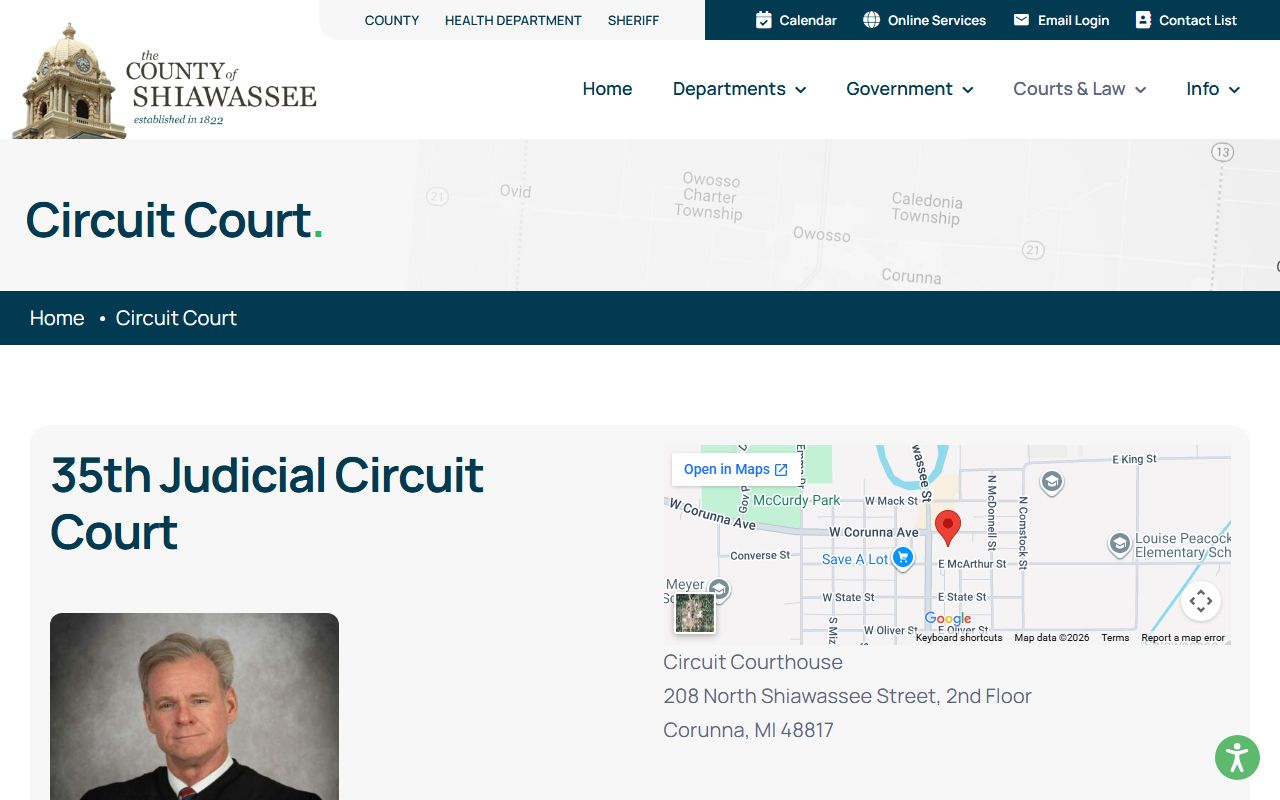
Chief Judge Matthew J. Stewart presides over the Circuit Court, and Judge Matthew S. McKone sits in the District Court. Each court keeps its own files, so the court level tells you where the record lives.
Shiawassee County Courthouses
The county's court offices cluster in downtown Corunna within a few blocks. The historic Circuit Courthouse on North Shiawassee Street holds the 35th Circuit Court, the County Clerk's Circuit records counter, and the Register of Deeds. One block away, the Courts and Defender Building on East Mack Street holds the 66th District Court, Probate Court, Family Court, the Public Defender, and Pretrial Services. The Sheriff's Office and jail sit close by on East McArthur Street.
Sheriff's Office & Jail
201 East McArthur Street
Corunna, MI 48817
989-743-3411
Circuit Court hours run Monday through Friday, 8:00 a.m. to noon and 1:00 p.m. to 5:00 p.m. The clerk's counter closes for lunch during the noon hour. Plan a visit around those windows to reach a live records clerk.
Types of Court Records in Shiawassee County
Court records in Shiawassee County split by subject and by court. Criminal and large civil files sit in Circuit Court. Everyday tickets, misdemeanors, and smaller claims sit in District Court. Estates and guardianships sit in Probate Court, while divorce and custody live in the Circuit Court Family Division. Each court produces its own set of documents from filing through final order.
The main record groups look like this across the county's trial courts.
- Criminal records - Circuit Court holds felony files; District Court holds misdemeanor and traffic-crime files.
- Civil records - money disputes split by dollar amount between Circuit and District Court.
- Family and divorce records - the Circuit Court Family Division handles divorce, custody, and support.
- Probate records - estates, wills, guardianships, and conservatorships sit in Probate Court.
- Traffic records - the District Court logs tickets, civil infractions, and drunk-driving charges.
Michigan's trial-court structure page explains how circuit, district, and probate courts divide the work statewide.
Land records are a separate matter. Deeds and mortgages sit with the Register of Deeds, not the courts, so a title question does not belong at the Circuit Court counter.
What Shiawassee County Court Records Show
A court record is more than a verdict. It is a running file that tracks a case from the first filing to the last order. Michigan case numbers usually carry the filing year and a two-letter code that marks the case type. The docket, or Register of Actions, lists each step in date order. The table below breaks down the common fields you see in a Shiawassee County court file.
| Field | What It Shows |
|---|---|
| Case Number | Filing year plus a two-letter case-type code |
| Court | Circuit, District, Probate, or Family Division |
| Parties | Plaintiff and defendant, petitioner and respondent, or the People of Michigan and a defendant |
| Filing Date and Status | Filed, pending, disposed, bound over, dismissed, or sealed |
| Register of Actions | Dated list of filings, hearings, motions, and orders |
| Financial Fields | Fines, costs, restitution, bond, and any late penalty |
| Documents | Complaint, motion, order, judgment, sentence, or PPO |
Not every field appears in the free public view. Dates of birth and other private data stay hidden by rule. For the full picture, the court counter or a record request fills the gaps the online view leaves out.
Public Access Laws for Shiawassee County Court Records
Court records in Michigan are public by default, but they follow court rules, not the state's open-records act. That surprises many people. A Freedom of Information Act request to the court is the wrong first step, because the judicial branch is exempt from Michigan FOIA. Court files open under court rule except where law or a judge's order closes them. Sheriff and police reports, by contrast, do fall under FOIA.
Key Statutes and Rules:
MCR 8.119 - Trial courts keep case records under this rule, and files are public unless law, court rule, or a court order limits them.
MCR 1.109 (PII) - Filers must shield listed personal identifying data, and that protected information is not available to the public.
MCL 15.232 - The Michigan FOIA definition section leaves courts outside the general executive-branch records route.
MCL 780.621 - Michigan's set-aside statute governs how eligible convictions can be removed from public criminal history.
MCL 712A.28 - Juvenile court records stay closed and open only by court order.
Confidential categories sit alongside the open files. Juvenile cases, sealed and set-aside convictions, adoptions, and mental-health proceedings are restricted or closed. Protected identifying data became nonpublic under court-rule amendments effective April 1, 2022. Social Security numbers, financial account numbers, dates of birth, and protected addresses should not be treated as public web data.
To view a sealed or restricted file, a person usually needs a court order or a specific legal right to the record. A set-aside affects how a conviction shows through the Michigan State Police, not just the court file itself. Anyone clearing a record should check eligibility under the Clean Slate statutes before filing.
Note: Because the judiciary sits outside Michigan FOIA, start with MiCOURT or the court counter for court files and save FOIA requests for sheriff and police records.
Searching Cases in the MiCOURT Portal
MiCOURT Case Search is the free statewide tool for participating Michigan courts. Shiawassee's Circuit, District, and Probate pages each link a case-inquiry path into it. The portal runs on JavaScript, so exact field labels can shift by court and update. The core search options stay steady: pick a court, then search by case number or by party name. The table below lays out the fields the public search commonly exposes.
| Field Label | Type | Required | Notes |
|---|---|---|---|
| Court | Selector | Usually required | Choose the 35th Circuit, 66th District, or Shiawassee Probate Court |
| Search type | Tab or radio | Required | Case number or participant name |
| Case Number | Text | Conditional | Best match when the full number is known |
| Last / Party Name | Text | Conditional | Used for a person or participant search |
| First Name | Text | Optional | Narrows a name search |
| Case Type | Filter | Optional | Civil, criminal, traffic, family, or probate by court |
Open MiCOURT Case Search from the county's court pages rather than a search-engine result. The public view hides non-public cases and private details. For records not shown online, the clerk counter or a court record request remains the reliable route.
Specialty Programs in Shiawassee County
Shiawassee County does not publish a separate drug court, veterans court, or sobriety court page in its official court navigation. Its strongest problem-solving program is Pretrial Services. The unit screens adult felony and misdemeanor defendants before their first appearance. It uses PRAXIS, a pretrial risk-assessment tool that scores the odds of a missed court date or a new arrest. That score supports a release recommendation to the judge.
The Friend of the Court office rounds out the county's family-support services.
Friend of the Court handles child support, custody, and parenting-time enforcement tied to Family Division cases. It runs payment access through state child-support systems and offers an arrears-management program. Pretrial Services checks District, Circuit, Probate, and Secretary of State records during screening, which shows how closely these offices work together.
Shiawassee County Sheriff and Jail
Sheriff Doug Chapman leads the Shiawassee County Sheriff's Office at 201 East McArthur Street in Corunna. The office runs the county jail, serves court papers, and handles road patrol and dispatch. The business line is 989-743-3411, and the anonymous tip line is 989-720-8477. The county does not appear to post a public online jail roster, so current custody information comes from the jail phone line at 989-743-2230.
Have a full legal name and, if possible, a date of birth or booking date ready before calling. For the full booking picture, the Shiawassee County inmate records page walks through the jail lookup and contact steps, and the warrant records page covers how to check a warrant. For sentenced state prisoners, the Michigan Department of Corrections OTIS search covers supervision status instead of the county jail.
Note: Police agencies never demand warrant or fine payment through gift cards, barcodes, or apps, so treat any such call as a scam and confirm through official numbers.
Marriage, Divorce, and Probate Records
Vital records and family cases spread across two offices. The County Clerk issues marriage licenses and certified copies of marriage, birth, and death records. Divorce is a court case, filed in the Circuit Court Family Division. Probate handles estates, wills, guardianships, and conservatorships. A state divorce certificate from vital records is not the same as the divorce decree, which lives in the court file.
- Testator
- A person who leaves a valid will.
- Executor
- The person named to carry out a will.
- Conservator
- A person appointed to manage another's finances.
- Guardian
- A person appointed to care for a minor or a protected adult.
The Family Court page outlines its reach over divorce, custody, support, and adoption.
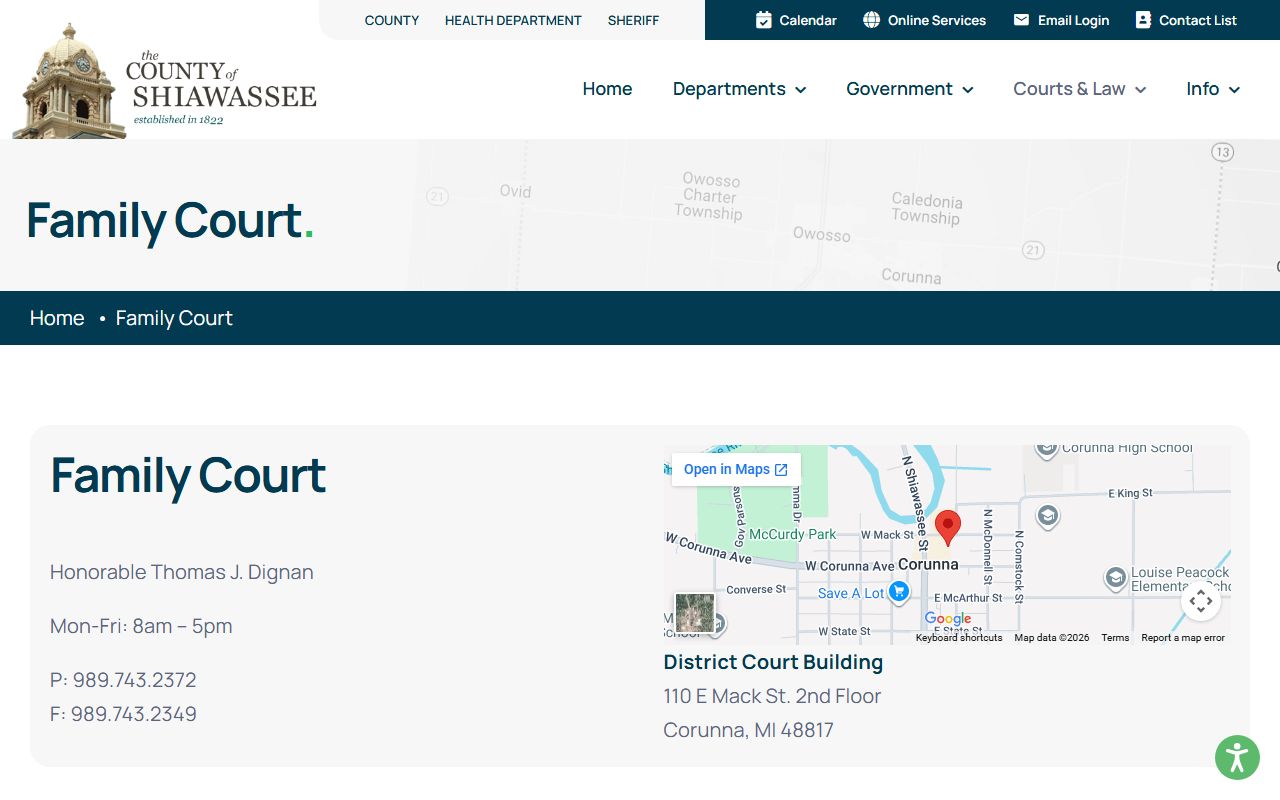
Many family filings stay open to the public, but adoption, juvenile, and protected-child details are restricted. Probate estate files tend to be more open than mental-health files. Certified copies of marriage and death records cost a set fee at the clerk's counter.
Federal Courts for Shiawassee Residents
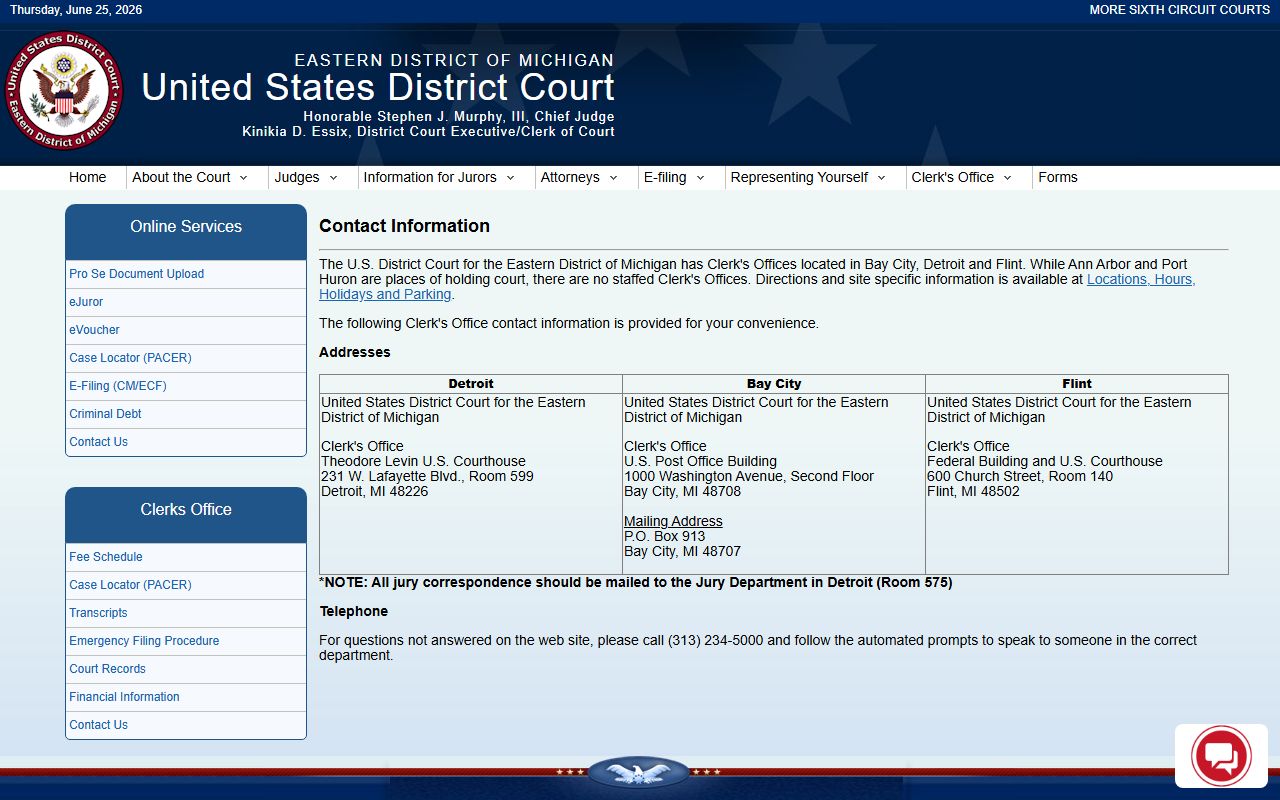
Federal cases are not in the county's MiCOURT system. Shiawassee County falls in the U.S. District Court for the Eastern District of Michigan, Southern Division. That court hears federal crimes, civil-rights suits, and federal-question disputes. The Flint federal courthouse at 600 Church Street is the nearest location for many county residents, with other sites in Detroit, Ann Arbor, Bay City, and Port Huron.
The Eastern District of Michigan contact page lists courthouse locations and clerk hours.
Federal case files come through PACER, the fee-based case-search service. An account is required, and charges may apply per page. For a free alternative on many opinions and dockets, CourtListener gathers court decisions in one searchable place.
CourtListener is not the official court record, so verify anything important against PACER or the clerk. For federal bankruptcy, the Eastern District Bankruptcy Court handles filings through its own clerk offices.
Shiawassee County Court Records Fees
Copy and certification fees for county records are set at the County Clerk's office. Court filing fees are set by state schedule and vary by case type. The most common counter fees cover certified vital records and business registrations. The table below lists the standard clerk fees for Shiawassee County records.
| Item | Amount |
|---|---|
| First certified copy (birth, death, marriage, genealogy, naturalization) | $25.00 |
| Additional certified copy of same document | $10.00 |
| Mail-in vital-record postage | $3.00 flat |
| Genealogy / naturalization search (records from 1932 or earlier) | $10.00 per name |
| DBA / business registration, new filing | $20.00 |
| DBA / business registration, renewal | $18.00 |
| DBA certified copy | $2.00 |
Circuit Court fines, costs, and restitution can be paid in person, by mail, or online. Personal checks are accepted up to $500. Online payments add an enhanced-access fee tied to the payment amount. Under MCL 600.4803, failure to pay within 56 days can add a 20 percent late penalty.
Legal Terms in Shiawassee County Records
Court files use words that carry exact meanings. A quick glossary makes a docket easier to read. These terms appear across Shiawassee County criminal, civil, family, and probate files.
- Plaintiff
- The party who starts a civil case by filing a complaint.
- Defendant
- The party sued in a civil case or charged in a criminal case.
- Petitioner
- The party who files a petition in probate, PPO, or family matters.
- Complaint
- The document that starts a civil or criminal case and states the claims.
- Information
- The formal felony charging document used in Circuit Court after bindover.
- Arraignment
- The first criminal appearance, where charges are read and bond is set.
- Preliminary examination
- A District Court hearing that tests probable cause before a felony bindover.
- Bindover
- The transfer of a felony from District Court to Circuit Court.
- Disposition
- The outcome of a case or a charge.
- Restitution
- Money a court orders to compensate a victim.
- Set aside
- The process that removes an eligible conviction from public criminal history.
History of Shiawassee County Courts
Shiawassee County takes its name from the Shiawassee River, which winds past Corunna and Owosso toward Saginaw Bay. The county's court system is old by Michigan standards. The first term of the Circuit Court met on December 4, 1837, and the first Probate Court session followed on February 13, 1838. In 1839, the county board accepted a public-square block in Corunna, and the first courthouse rose on that site.
A tour of the county's About Us history page lays out those founding dates and the courthouse story.
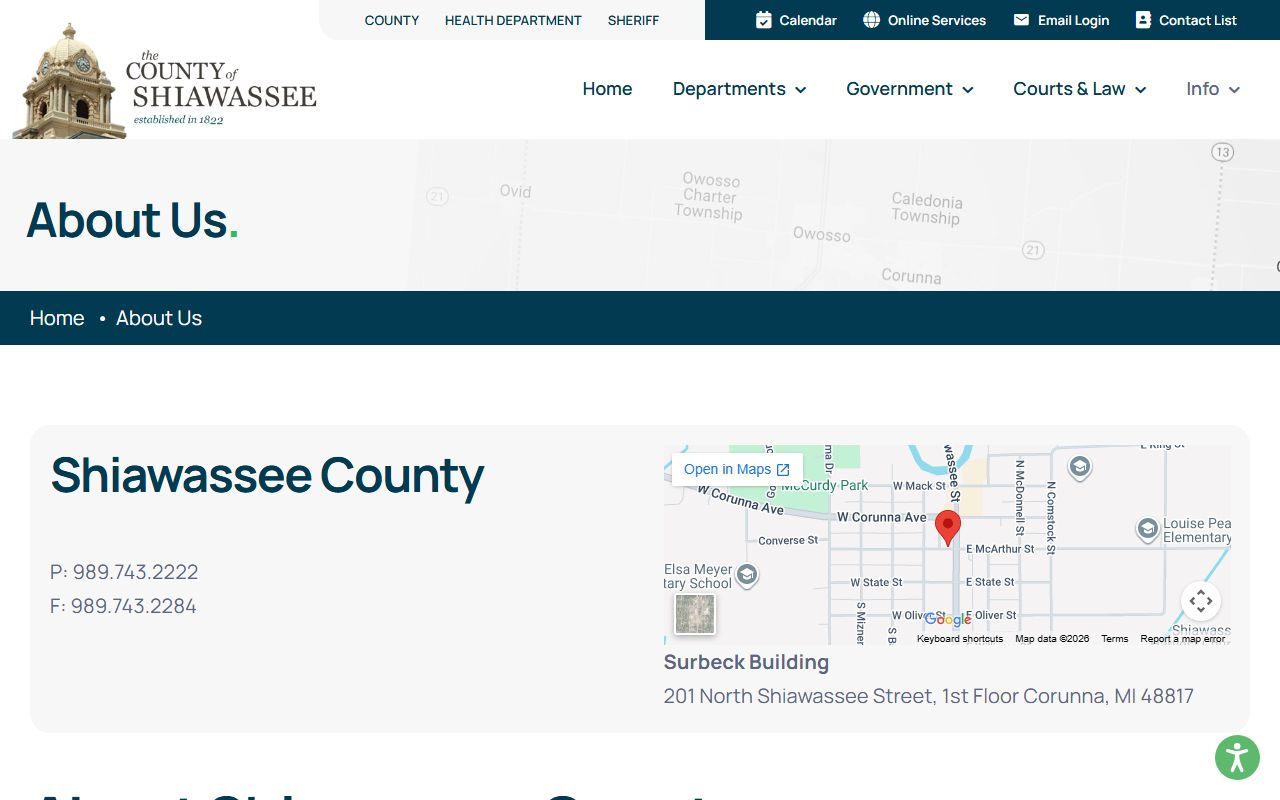
The present courthouse dates to 1903 and 1904. Architect Claire Allen designed it in the Classical Revival style, and it stands as a Michigan State Historic Site on the National Register of Historic Places. Its limestone walls and clock tower still mark the county seat. The District Court arrived later, created by the Legislature in 1968, and a Family Division was added to the Circuit Court in 1998.
Recent Court Access Changes
Filing rules in Shiawassee County shifted through 2025. On November 6, 2025, the 66th District Court began accepting civil documents through MiFILE, the state e-filing system, and attorneys filing civil matters must now e-file. The Circuit Court moved the other way. Since July 1, 2025, the County Clerk no longer accepts ordinary court filings by email, because Shiawassee is not an e-filing county for Circuit Court. Documents must arrive in person or by mail, though a few emergency motions remain email-eligible.
County job postings show steady court and public-safety hiring, from assistant prosecutors to correction deputies.
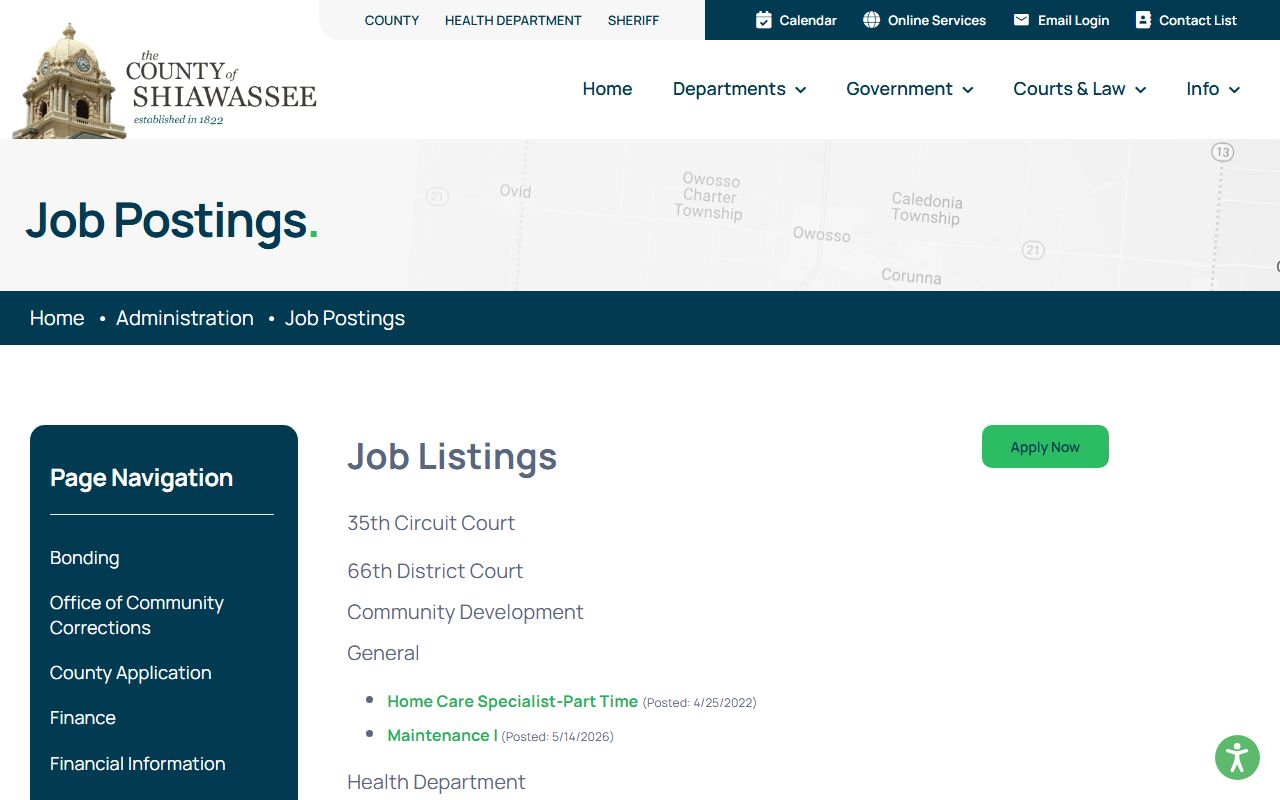
Those county job postings hint at the staffing that keeps the courts and jail running. A local warning also stands out: in early 2025, a scam caller posed as a Shiawassee sheriff's lieutenant and demanded warrant payment by barcode. No agency collects fines that way, so verify any such contact through official numbers.
Frequently Asked Questions
How do I search Shiawassee County court records online?
Use MiCOURT Case Search, the free statewide portal linked from the county's Circuit, District, and Probate Court pages. Pick the Shiawassee court, then search by case number or party name. The public view shows case type, status, docket entries, and hearing dates, but it hides private details and non-public cases.
Are Shiawassee County court records covered by Michigan FOIA?
No. The judicial branch is exempt from Michigan's Freedom of Information Act. Court files open under court rule instead, and they are public unless law or a judge's order closes them. Sheriff and police reports do fall under FOIA, so those go through the Sheriff's records channel rather than the court.
Which Shiawassee court handles my case?
Felonies, civil claims over $25,000, divorce, and PPO matters go to the 35th Circuit Court. Misdemeanors, traffic tickets, small claims, and landlord-tenant cases go to the 66th District Court. Estates, wills, guardianships, and name changes go to Probate Court. The case type points to the court.
Does Shiawassee County have an online jail roster?
The county does not appear to publish a public online jail roster. Current custody information comes from the jail phone line at 989-743-2230. Have the person's full legal name and, if possible, a date of birth or booking date ready before calling. State prison status is tracked separately through MDOC OTIS.
How do I get a certified copy of a record?
Certified copies of marriage, birth, and death records come from the County Clerk for $25.00 for the first copy and $10.00 for each additional copy of the same document. Mail requests add flat postage. Court file copies come from the court that holds the case, at the counter or by record request.
Can I file Circuit Court documents by email?
No. Since July 1, 2025, the County Clerk no longer accepts ordinary Circuit Court filings by email. File in person or by mail at the Circuit Courthouse. Only emergency civil and domestic motions, PPO petitions, and PPO show-cause motions may still be emailed. The District Court accepts civil e-filing through MiFILE.
How do I check for a warrant in Shiawassee County?
No official online warrant list exists here. Contact the court that holds the case or the police agency handling the matter. The prosecutor's office cannot confirm whether a warrant is still open. Never pay an alleged warrant to a caller demanding gift cards or barcodes, since that is a known scam.
Where are federal cases for Shiawassee residents?
Shiawassee County sits in the U.S. District Court for the Eastern District of Michigan, with a courthouse in Flint. Federal case files come through PACER, which requires an account and may charge fees. CourtListener offers a free look at many opinions and dockets, though it is not the official record.