
What Probate Covers in Shiawassee County
The Shiawassee County Probate Court handles a wide slate of matters. It manages wills, deceased estates, and trusts. It hears petitions for assignment of property. It appoints guardians and conservators for adults and minors, including guardianships for people with developmental disabilities. The court also handles mental health commitments, name changes, and secret marriage cases.
All of this sits in one court. The Probate Court is located at 110 East Mack Street, second floor, in Corunna, Michigan. That is the Courts and Defender Building, one block from the main Circuit Courthouse. The phone line is 989-743-2211, and the fax is 989-743-2223. Court staff cannot give legal advice or guidance, so many families work with an attorney or use the state's self-help forms.
The court's reach is wider than estates alone. Along with wills and trusts, its list of services includes civil lawsuits tied to probate matters, developmentally disabled guardianships, and mental commitments. Each of these carries its own forms and its own privacy rules. Probate is where a family turns after a death, but it is also where a guardian is named for a parent who can no longer manage a household.
The Shiawassee County Probate Court page lists these services and the current filing rules. It is the most reliable starting point for a probate question.
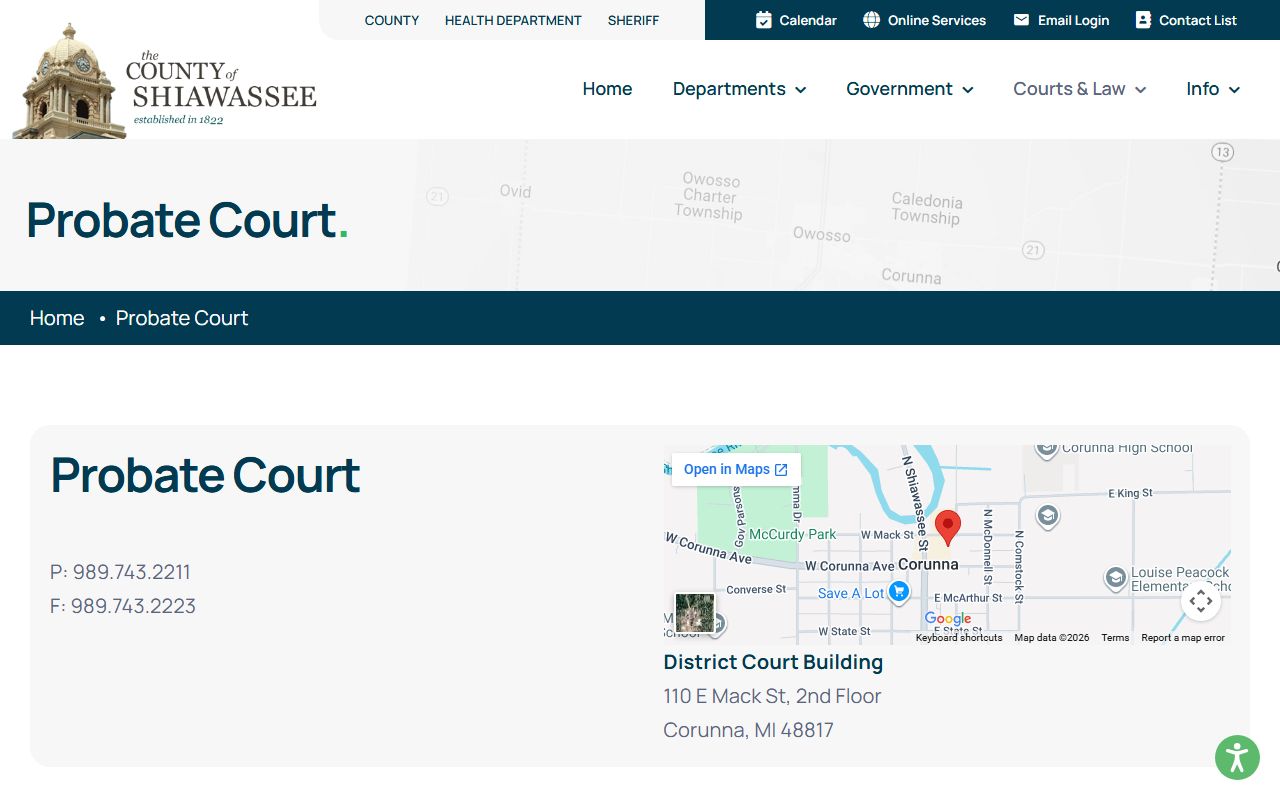
The same court that opens an estate also oversees the guardian who protects a vulnerable adult, which keeps related family matters together.
Probate Terms Defined
Probate paperwork uses words that rarely come up in daily life. A short glossary makes the filings easier to read. These five terms show up in almost every estate and guardianship file.
- Testator
- The person who made the will. Their wishes guide how the estate is divided.
- Executor
- The person named in the will to carry it out. Michigan often calls this role the personal representative.
- Intestate
- Dying without a valid will. State law then decides who inherits.
- Guardianship
- A court order giving one person the duty to make personal and care decisions for another who cannot.
- Conservatorship
- A court order placing a person's money and property under the control of an appointed conservator.
Note: Guardianship covers personal care while conservatorship covers finances, and one case can involve both roles for the same protected person.
How to Search Shiawassee County Probate Court
Public probate cases can be checked online, but not every record shows up there. Estate files are generally more open than mental health files. Start with the county's case inquiry link, then use the court counter for anything the portal will not show. The state case system is not a real-time file cabinet, and older or sealed matters may only exist on paper at the court.
- Open the Probate Court case inquiry link, which routes to the statewide MiCOURT case search.
- Select the Shiawassee Probate Court and search by case number if you have it, or by party name.
- For files not shown online, or for certified copies, contact the Probate Court directly at 989-743-2211 or visit the counter.
The Probate Court case inquiry page is the county's link into the case system. It points to the same MiCOURT case search that serves the other Shiawassee courts.
Because confidential guardianship and mental health matters are limited, a name search may return only the cases the public is allowed to view.
Probate Court in Shiawassee County
Shiawassee County runs a single Probate Court, so every estate, guardianship, and name change flows to the same address. The court shares the Courts and Defender Building with the District Court and the Family Court. Filings arrive by U.S. mail or in person Monday through Friday, from 8:00 a.m. to 5:00 p.m.
Shiawassee County Probate Court
110 East Mack Street, 2nd Floor
Corunna, MI 48817
Phone: 989-743-2211
Fax: 989-743-2223
Mon-Fri 8:00 a.m. - 5:00 p.m.
One rule surprises many filers. The court does not accept email filings at this time. In-person filing may not be finished while you wait, so plan for a return trip or a mailed follow-up.
Probate Case Types in Shiawassee County
Probate is not one process. It is a group of related case types, each with its own path and paperwork. The table below groups the main matters the Shiawassee County Probate Court handles and what each one covers.
| Case Type | What It Covers |
|---|---|
| Deceased estate | Settling the property, debts, and distributions of a person who has died. |
| Trust proceeding | Oversight of a trust and its trustee. |
| Assignment of property | A petition to transfer a small estate without full administration. |
| Guardianship | Care and decision authority for an adult, minor, or person with a developmental disability. |
| Conservatorship | Control of the money and property of a protected person. |
| Mental commitment | Court-ordered treatment matters, with strong privacy limits. |
| Name change / secret marriage | Petitions to change a legal name or record a confidential marriage. |
The Probate Court does not post a public fee schedule on its own page, so the filing cost for each type is a gap. Use the current statewide SCAO fee schedule or call the Probate Court at 989-743-2211 to confirm the fee before you file. The court directs filers to the SCAO forms on the Michigan Courts trial court site.
Small Estates in Shiawassee County
Not every estate needs a full, supervised probate. Michigan allows a shorter path for smaller estates. A petition and order for assignment of property lets an heir transfer assets without the longer process. The rules live in state statute.
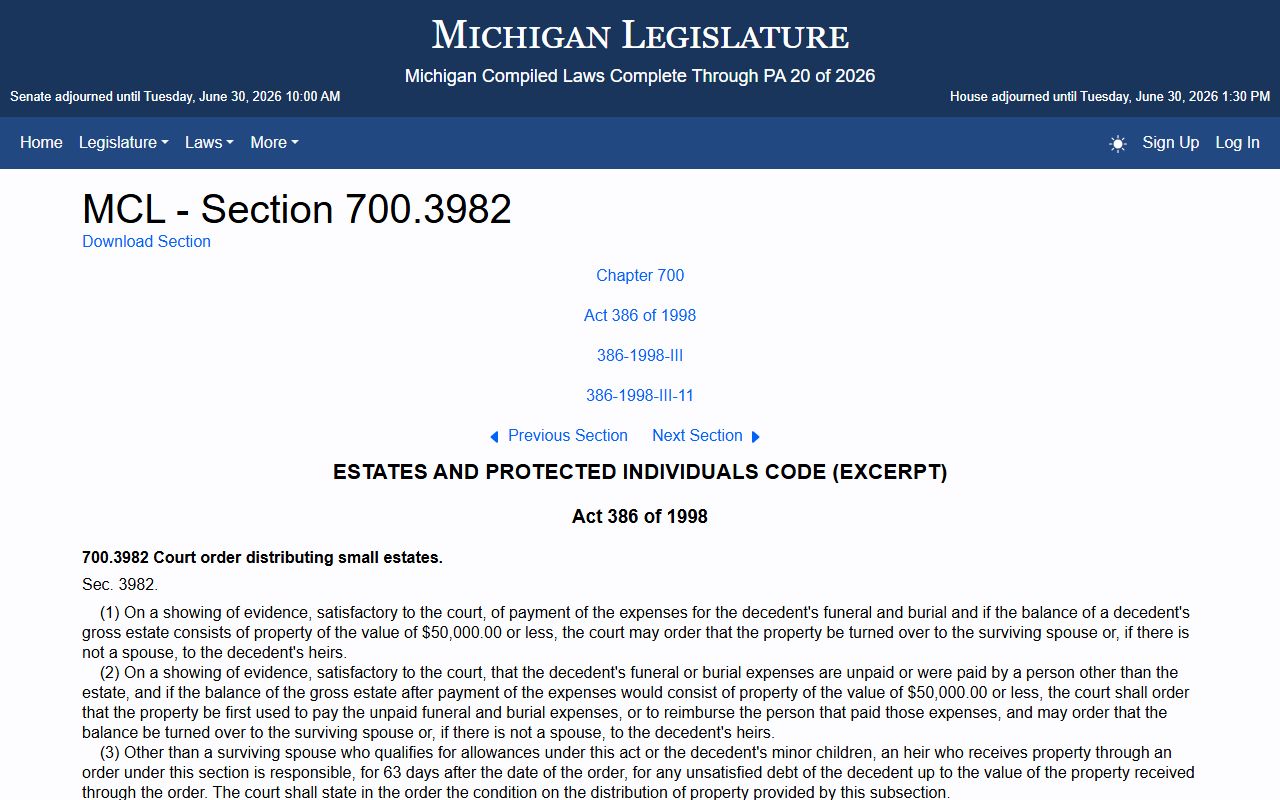
The small-estate route is set by MCL 700.3982, which governs the petition and order for assignment of property. The statute lists a gross-estate threshold, with deductions for funeral and burial expenses and certain real-property liens. Those dollar limits are adjusted by date, so the figure that applies depends on the date of death. Do not rely on an old number.
You can read the statute on the Michigan Legislature MCL 700.3982 page before you file. Always confirm the current threshold with the Shiawassee County Probate Court, since the amount changes over time.
Whether a small-estate assignment, informal administration, or supervised administration fits depends on the estate's size and any disputes among the heirs. A calm estate with a clear will and cooperative heirs may qualify for the lighter informal path. A contested estate, or one with complex assets, often needs the full supervised process, where the court reviews each major step. The Probate Court cannot tell a filer which route to pick, so legal advice or the SCAO self-help materials fill that gap.
What Shiawassee County Probate Records Show
A probate file grows as a case moves. Early on, it holds the petition and, for an estate, a reference to the death certificate and the will. As the case runs, the court adds letters of authority, an acceptance of appointment, and a notice to creditors.
Later filings round out the record. Expect an inventory of assets, proof of publication and service, accountings, and annual reports from a guardian or conservator. Orders and closing documents finish the file. For related family and vital documents, such as a marriage certificate needed to prove a spouse's claim, the county's marriage and divorce records office is a separate stop. Broader case history across the county's courts sits with the general court records system.
A typical estate moves in stages. The court opens the case, appoints a personal representative, and sets a period for creditors to make claims. The representative gathers assets, files an inventory, and pays valid debts and taxes. Accountings show the court where the money went. Once claims and distributions are done, the court reviews the final accounting and enters closing orders. A guardianship or conservatorship runs longer, with reports filed year after year until the court ends it.
Restricted Probate Records
Public access to probate files varies by case type. Estate files are usually the most open. Guardianship and conservatorship records can hold sensitive medical, financial, and protected-person details, so parts stay shielded.
Mental health commitment files carry the strongest privacy limits. Name change and secret marriage cases can raise their own statutory privacy issues. Guardianships tied to juveniles may follow the Family Division's confidentiality rules instead. When the portal will not show a record, the counter is the place to ask what the law allows.
Court records in Michigan are not open under the state Freedom of Information Act, because the judicial branch is exempt. Access to a probate file is governed by court rule and court order instead. That is why an estate file can be public while a guardianship report in the same building stays sealed. The distinction rests on the type of case, not on who is asking.
Note: A search may return no result because the record is confidential rather than missing, so ask the Probate Court counter when a public case seems to be hidden.