
Shiawassee County Arrest Records and Court Charges
An arrest record is the record of an arrest and booking. It notes who was taken into custody, which agency made the arrest, and when. In Shiawassee County the Sheriff and local police handle arrests, and the jail books the person. That booking side is custody information. It is not the same as a formal charge. The custody roster and booking detail live with the jail, and the jail listing is covered on the county inmate records page.
The court charge record begins later. After an arrest, the Prosecuting Attorney reviews the case and decides which charges to bring. The prosecutor authorizes a complaint, and the court opens a file. From that point the charges after arrest are tracked through the case. Charges can be amended, reduced, added, or dropped as the case develops. The full case file, with pleas, disposition, and sentence, sits on the county criminal court records page. This page stays focused on the arrest-to-charge pathway.
Three offices split these roles. The prosecutor authorizes the complaint. The court authorizes any arrest warrant. The police agency makes the arrest and books the person. Because of that split, the Prosecuting Attorney's office will not confirm by phone whether a charge has issued or whether a warrant is still open. That status is held by the court and the arresting agency, so a warrant question goes to the police who handle the case.
Local legal terms that appear in these records are defined on the county glossary of terms.
That glossary covers complaint, defendant, and motion, which all appear once charges after arrest reach the court record.
How to Find Shiawassee County Arrest Records and Charges
Court charges show up in the case index, not on a public mugshot board. The main tool is MiCOURT Case Search, the state's public case portal. It shows charges, charge codes, and charge status for participating Michigan courts. Arrest and booking detail comes from the jail phone line instead, since the county does not publish a web jail roster.
- Open MiCOURT Case Search from the county's District Court or Circuit Court case inquiry link.
- Search by defendant name or case number.
- Open the case and read the full charge list.
- Check each charge's code, severity level, and current status.
When the online view does not show enough, the court counters fill the gap. The 66th District Court takes record requests by email, with criminal requests sent to its criminal records address and civil requests to its civil address. A request should include the full name, phone, email, mailing address, case number, party name, and whether the requester wants a full file, a single document, a transcript, or the register of actions. Circuit Court files are viewed at the County Clerk's Circuit Court counter, since Shiawassee is not an e-filing county for Circuit Court.
Charges that ended in a conviction also roll up into a statewide history. The Michigan State Police run ICHAT at the state criminal-history site, which charges $10 per search. ICHAT shows Michigan convictions only. It does not confirm a pending charge, an arrest, or whether a warrant is still open. For those points, the court case file or the arresting agency is the better source.
How Charges Get Filed After an Arrest
Walk the path from arrest forward. The arrest and booking happen first. The charge record then begins when the prosecutor files a charging document with the court. Michigan uses three main types, and the one used depends on the offense and the stage. A misdemeanor and the felony first steps start with a complaint. A felony that clears its preliminary examination moves ahead on an information. A grand jury may return an indictment in serious cases.
| Complaint | Information | Indictment | |
|---|---|---|---|
| Filed By | Officer / Prosecutor | Prosecutor | Grand Jury |
| Common For | Misdemeanors and early felony steps | Felonies after bindover | Serious felonies |
| Starts | The case | The felony trial phase | The case |
In Shiawassee County, most felonies begin with a complaint and warrant in the 66th District Court. After arraignment and bond, the District Court holds a preliminary examination to test probable cause. If the case is bound over, the prosecutor files an information in the 35th Circuit Court. Each step changes the charging document but keeps the same case tied together.
The Prosecuting Attorney holds wide authority over which charges get filed. As the county's chief law-enforcement official, the prosecutor reviews and authorizes felony and misdemeanor violations of state law and county ordinances. That review decides whether an arrest becomes a formal charge at all. Some arrests never lead to a charge, while others produce several counts from one incident.
Charge Status and What It Means
Charges are not fixed once filed. They change as a case moves, and the record tracks each shift. A charge can be amended to a different offense, reduced through a plea deal, or dismissed outright. One arrest can lead to several charges that each end differently. Reading the status field for every count is the only way to know where things stand.
| Status | What It Means |
|---|---|
| Pending | The charge is filed and the case is still open with no final result yet. |
| Amended / Reduced | The charge was changed, often to a lesser offense through a plea agreement. |
| Dismissed | The charge was dropped by the court and did not lead to a conviction. |
| Nolle Prosequi | The prosecutor chose not to pursue the charge, ending it without a conviction. |
Note: A dropped or dismissed charge can still appear in the court record, so a clean outcome does not always mean the charge vanishes from the file.
Charge vs. Conviction in Arrest Records
An arrest and a charge are accusations, not proof of guilt. A conviction is different, since it takes a plea or a verdict. Many Shiawassee County arrest records lead to charges that never end in a conviction. The two must be read apart. The charge shows what was alleged, while the disposition shows what the court decided.
| Charge | Conviction | |
|---|---|---|
| Stage | Accusation | Verdict or plea |
| Burden of Proof | Probable cause | Beyond reasonable doubt |
| Public Record | Yes | Yes |
| Shows in ICHAT | No | Yes |
Charge Codes and Severity Levels
Every charge is tied to a statute or a local ordinance. That link is the charge code, and it tells you the exact offense alleged. Michigan sorts offenses into levels. Felonies carry the heaviest penalties and route through Circuit Court after bindover. Misdemeanors punishable by up to one year stay in District Court. Civil infractions, like most traffic tickets, are not crimes at all. One arrest can produce several separate charges, and each carries its own code and level.
The court tracking number, or CTN, ties a charge to the police case that started it. Reading the code, the level, and the status together shows how serious a charge is and where the case is headed. A high felony code with a pending status points to Circuit Court. A misdemeanor code with a dismissed status closed in District Court. A civil infraction code, common on traffic tickets, is not a crime and carries no jail term.
Note: One arrest can generate several charges at different levels, so the most serious count often decides which court hears the case.
Statewide Charge and Criminal History Lookups
County charges feed into statewide systems once a case reaches certain points. The Michigan State Police ICHAT service is the main statewide criminal-history lookup. It costs $10 per search and shows Michigan convictions only, not pending charges or arrests. That limit matters, because a recent arrest may not appear there at all.
For a person under state supervision, the Michigan Department of Corrections tracks scope on the OTIS overview page.
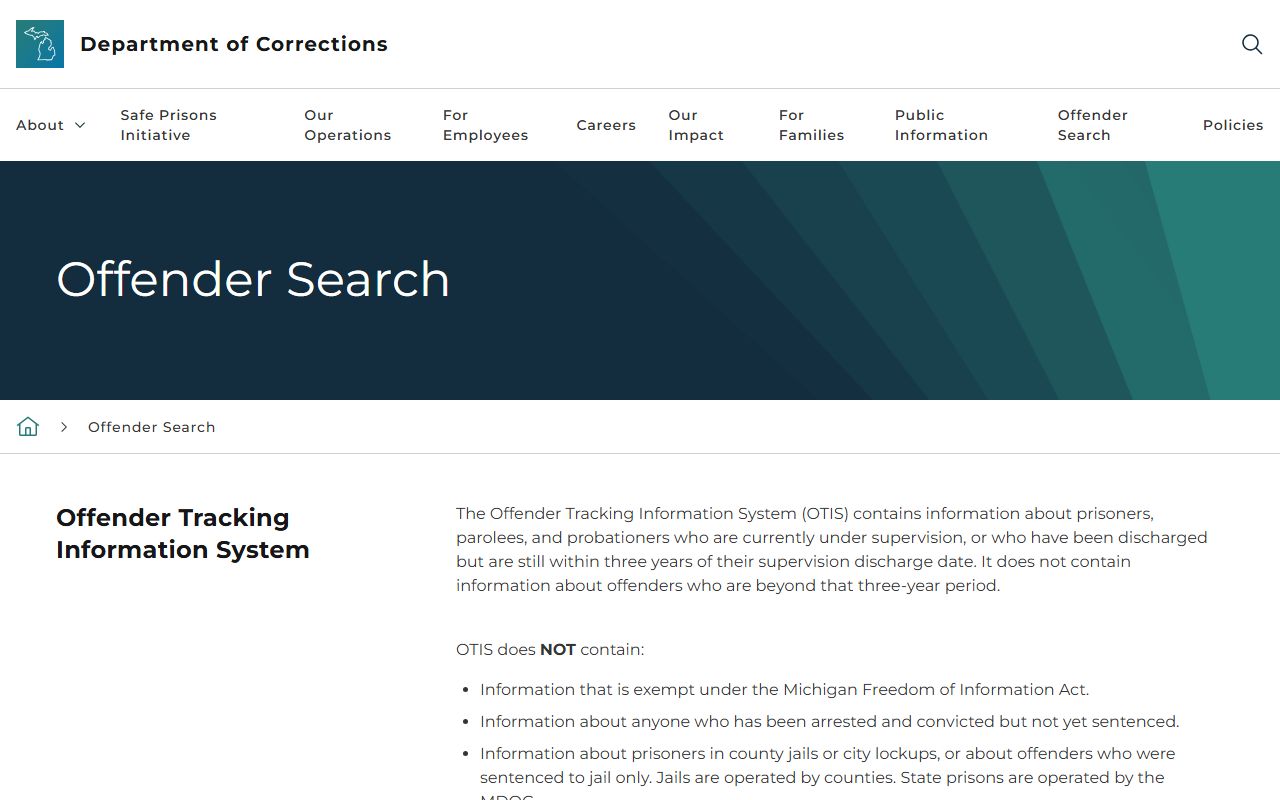
OTIS lists people currently under supervision or discharged within the past three years, so it covers convictions and sentences rather than raw arrest records.
The arrest report itself is a different kind of record. Court charge records open under court rule, but arrest and booking reports are law-enforcement records. Those come from the Sheriff's records office through a public-records request, not the court clerk. A crash report tied to an arrest works the same way. So a full picture may pull from the court file, the jail, and the Sheriff's report channel, each with its own path.
Sealed vs. Expunged Charge Records
Some charges leave public view over time. Michigan mainly clears records by setting aside an eligible conviction, which removes it from public criminal history. That is close to expungement in other states. Sealing hides a file while it still exists. The automatic Clean Slate program set aside many qualifying convictions without an application, so an older charge may no longer show up.
- Sealed
- The file is hidden from public view but still exists, and this happens only in limited cases by court order.
- Expunged / Set-Aside
- The conviction is removed from public criminal history through Michigan's set-aside process or the automatic Clean Slate program.
- Effect on a charge search
- A sealed or set-aside charge should not appear in a routine public lookup, though the court file may remain.
Background Check Considerations
A casual charge lookup is not a background check under federal law. The Fair Credit Reporting Act governs reports used for jobs, housing, credit, or insurance. Reports for those uses must come from a compliant source. An arrest records search for personal knowledge is fine, but it cannot serve as a legal screening. A single arrest with no conviction should never be treated as proof of a crime.
Important: Arrest and charge records read for screening are not a consumer report under the Fair Credit Reporting Act, and they may not be used to decide employment, housing, credit, or insurance.
Restricted Charge Records in Shiawassee County
Not every charge is open to the public. Some Shiawassee County arrest records and charges are restricted by law. Juvenile charges are the clearest example, since Michigan opens juvenile court records only by court order. Sealed and set-aside charges also leave public view. Ongoing investigations stay closed until an arrest or charge becomes public.
Protected personal details are held back as well. A charge search will not show these items:
- Juvenile charges, open only by court order.
- Charges tied to convictions cleared through Clean Slate.
- Dates of birth, Social Security numbers, and other protected identifiers.
- Sealed search warrants and charges from open investigations.