
Criminal Court Records in Shiawassee County
A criminal court record is the official case file a court keeps once charges are filed. It starts with the charging document and grows with each new filing. Every motion, hearing, plea, and order lands in it. The clerk who serves the court holds and updates the file. For felony matters the 35th Circuit Court file sits with the County Clerk, who is also the Circuit Court Clerk. For misdemeanors and the early felony steps, the 66th District Court keeps its own file. The record stays open while the case is active and closes at disposition.
Most criminal cases in Shiawassee County begin in the 66th Judicial District Court. That court handles adult misdemeanors punishable by up to one year, and it holds the first steps in felony cases. A felony starts with arraignment, bond, and a preliminary examination in District Court. If the judge finds probable cause, the case is bound over to the 35th Judicial Circuit Court. The Circuit Court is the general trial court for felonies and high-court misdemeanors. Both courts produce criminal records, so the file you need depends on the charge level. A closer look at the individual charges and how they change lives in the county arrest records and court charges.
The county Prosecuting Attorney decides which charges to bring, and that role is described on the Shiawassee County Prosecuting Attorney page.
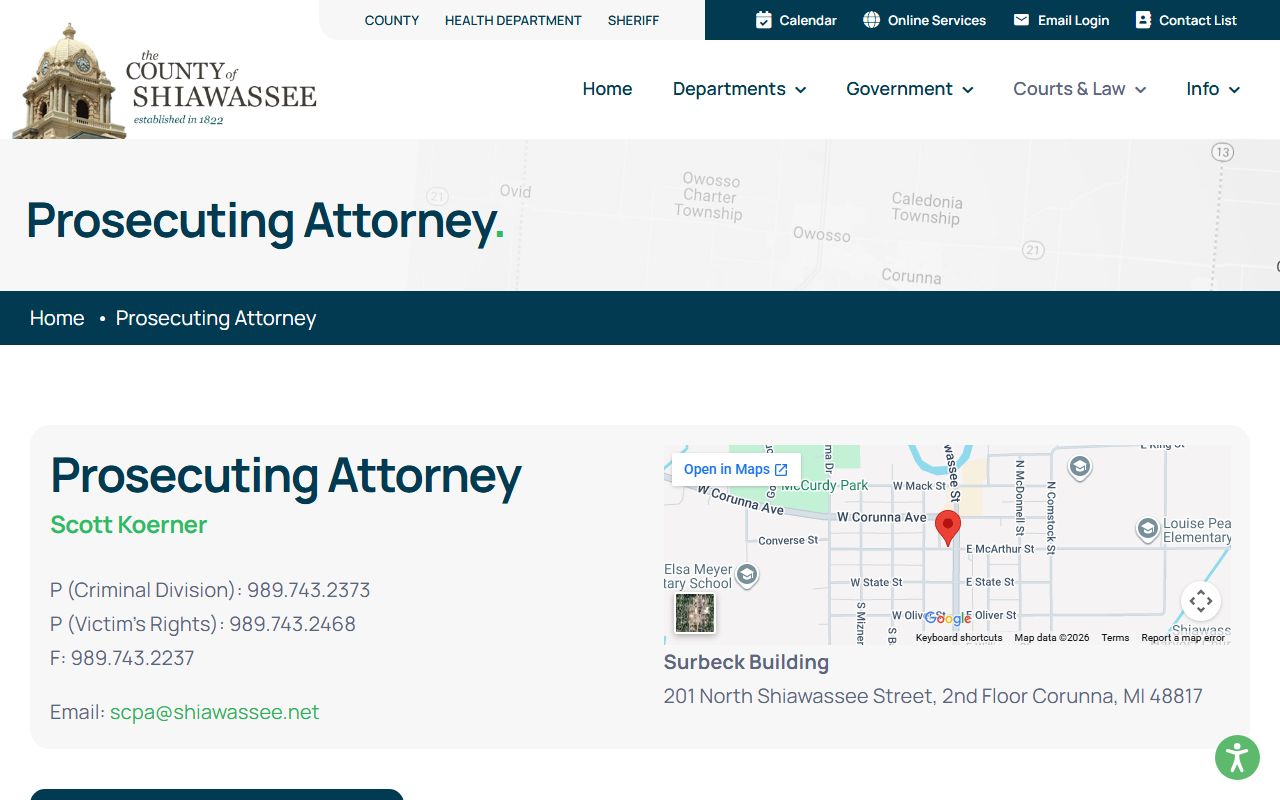
Prosecutor Scott Koerner reviews police work and authorizes the charges that open a criminal court record.
How to Search Shiawassee County Criminal Court Records
Shiawassee County criminal court records are searched first through MiCOURT Case Search, the state's public case portal. The county Circuit Court, District Court, and Probate Court pages all point users to it. MiCOURT covers criminal, civil, traffic, family, and probate cases for participating Michigan courts. A search returns case numbers, parties, charges, and docket entries where the case is public.
- Open MiCOURT Case Search from the county's District Court or Circuit Court case inquiry link.
- Search by defendant name or by the case number if you have it.
- Narrow the results by court, case type, and filing date.
- Open a case to read the register of actions, charges, and disposition.
- Request a certified copy from the clerk when you need an official document.
MiCOURT is a case system, not a criminal-history database. For a statewide conviction history, the Michigan State Police run ICHAT, which charges $10 per search and shows Michigan convictions only. ICHAT does not list pending charges, dismissed counts, or warrant status. To see a full criminal court file with every filing, the court counter or a written request works better than any single lookup. The broader picture of every court file type lives in the county court records.
Charging paperwork and related filings appear on the prosecutor's documents and forms page.
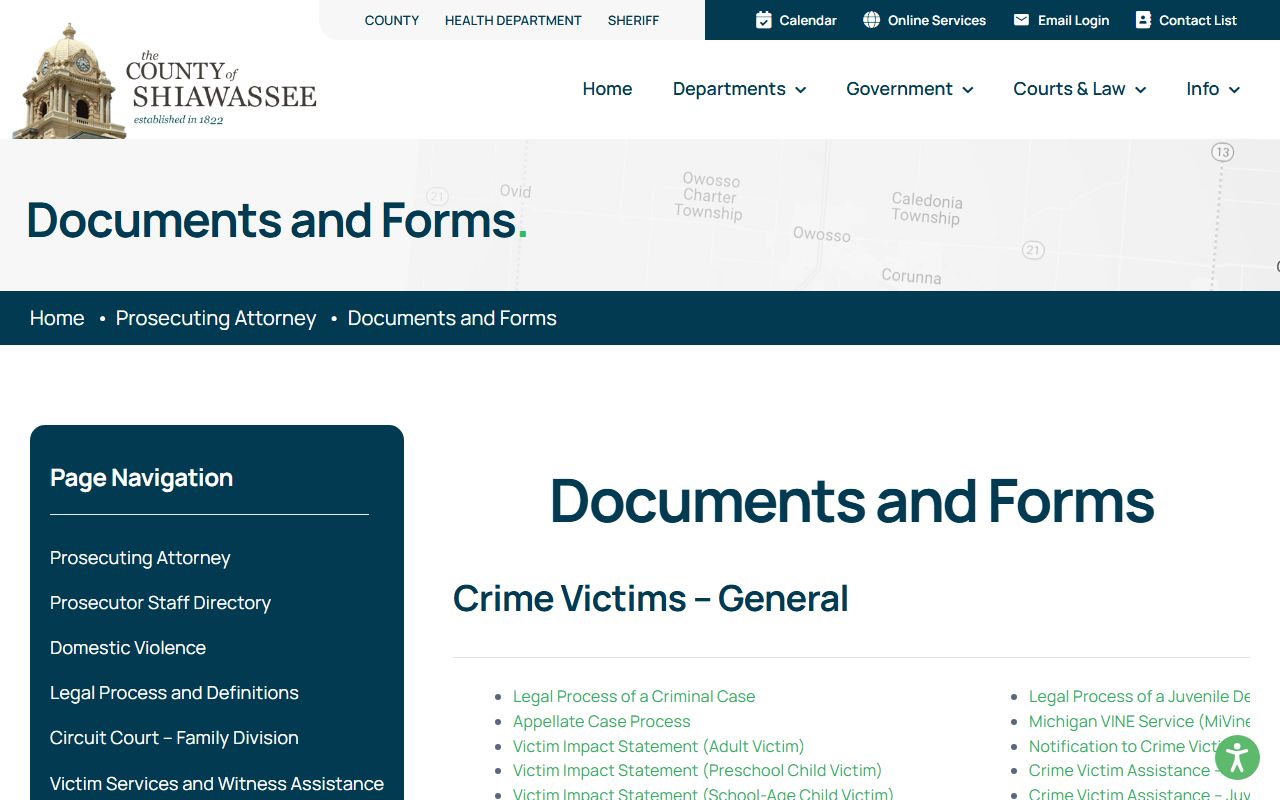
Those forms cover search warrants, certifications, and juvenile matters that shape what a criminal court record contains.
Stages of a Shiawassee County Criminal Case
A criminal case moves through set stages, and each one leaves a mark in the record. The path starts when charges are filed and ends at sentencing if there is a conviction. Knowing the stages helps you read where a case stands.
Case flow: Charges Filed › Arraignment › Preliminary Exam / Bindover › Pretrial › Plea or Trial › Disposition › Sentencing
At arraignment the defendant hears the charges and enters a first plea, and the judge sets bond. A preliminary examination in District Court tests whether there is probable cause for a felony. If there is, the case binds over to Circuit Court. Pretrial covers motions, plea talks, and scheduling. Many cases end with a plea, while others go to trial before a judge or jury. Disposition records the result of each charge. Sentencing sets the punishment after a conviction, from fines and probation to jail or prison.
Before the first appearance, county Pretrial Services may screen an in-custody defendant and recommend release conditions, a step outlined on the Shiawassee County Pretrial Services page.
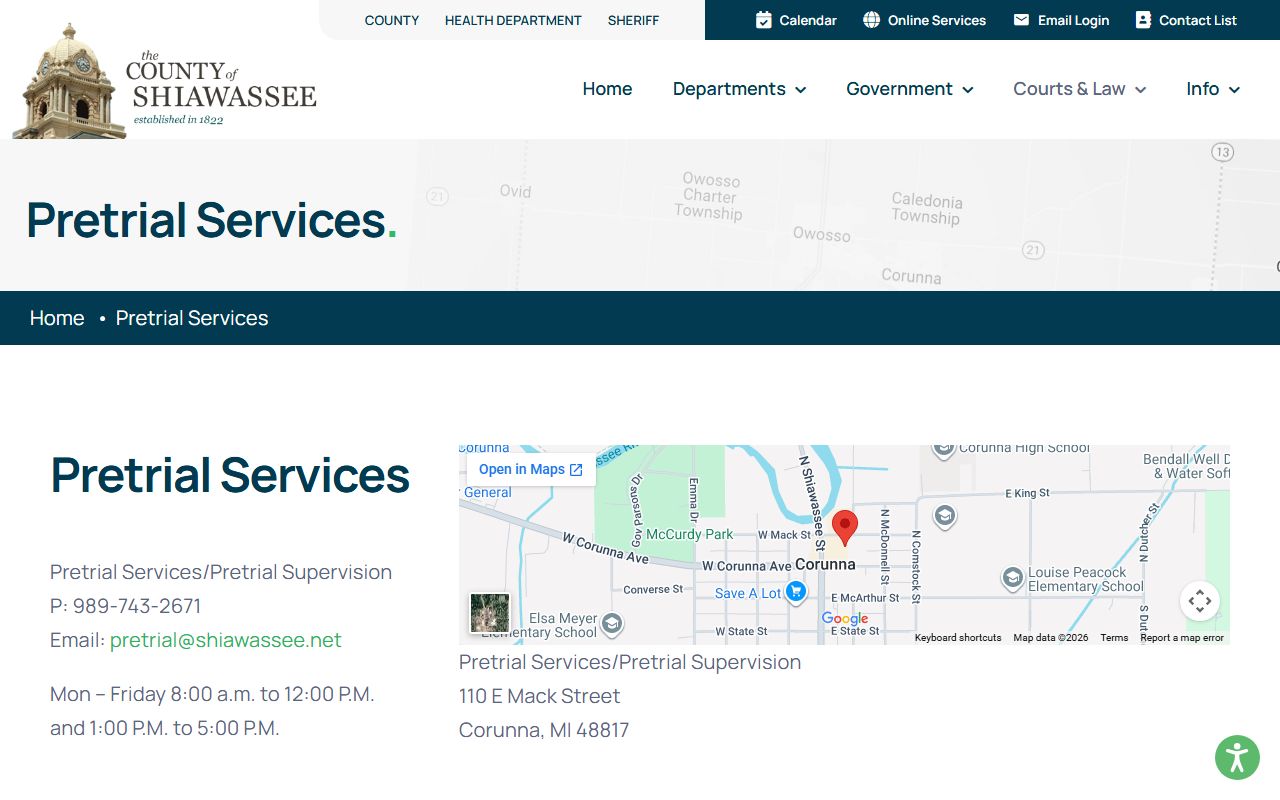
The unit uses the PRAXIS risk tool to weigh the chance of a missed court date or new arrest, and its recommendation can appear in the case record.
Note: A guilty plea and a dismissed charge both appear in the record, so the outcome of each count must be read line by line.
What a Shiawassee County Criminal Court Record Shows
A Shiawassee County criminal court record is built from labeled fields. Each one answers a plain question about the case. Read together, they show who was charged, with what, and how it ended.
| Field | What It Shows |
|---|---|
| Case Number | A unique file number that often carries the filing year and a two-letter code for the case type. |
| Defendant | The person charged; criminal cases are captioned People of the State of Michigan against the defendant. |
| Charges | Each offense listed with its statute or ordinance and its severity level. |
| Plea | The defendant's formal answer, such as guilty, not guilty, or no contest. |
| Disposition | The result of each charge, from conviction to dismissal or acquittal. |
| Sentence | The punishment after a conviction, including jail, probation, fines, costs, and restitution. |
Financial fields often sit beside the sentence. Court records can list fines, costs, restitution, and any late penalty. Michigan law adds a 20 percent penalty when a court obligation goes unpaid past 56 days. The docket, also called the register of actions, ties it all together in date order.
Reading Dispositions and Sentences
The disposition is the heart of a criminal court record. It tells you whether a charge ended in a conviction, a dismissal, or an acquittal. A single case can hold several charges with different outcomes. One count may end in a guilty plea while another is dropped.
- Guilty plea
- The defendant admits the charge, and the court enters a conviction.
- No contest
- The defendant does not fight the charge but does not admit guilt; the court still treats it as a conviction.
- Dismissed
- The charge is dropped and does not end in a conviction.
- Deferred
- A finding is held back while the defendant meets conditions, and the charge may later be dismissed.
- Probation
- Court-ordered supervision served instead of or after jail.
- Restitution
- Money the court orders paid to a victim.
A defendant who cannot afford a lawyer may be represented by the county Public Defender, whose office is profiled on the Shiawassee County Public Defender page.
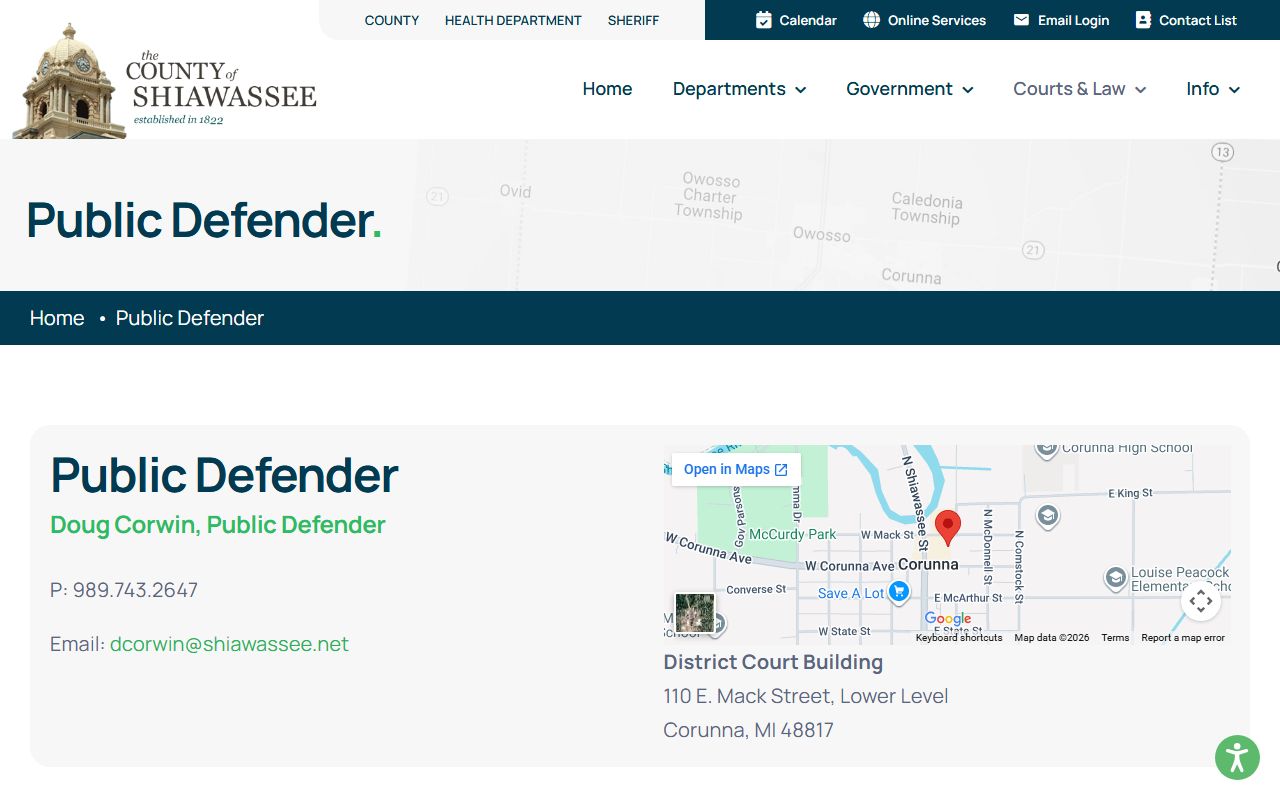
Director Doug Corwin and the defense staff appear in the record through motions, appearances, and plea agreements that shape the final disposition.
Charges vs. Convictions in County Records
Being charged is not the same as being convicted. A charge is an accusation, and it stays in the criminal court record even if it never leads to a conviction. Many Shiawassee County criminal court records show charges that were dropped, dismissed, or ended in acquittal. Reading the disposition for each count keeps the two apart.
| Charge | Conviction | |
|---|---|---|
| Stage | Accusation | Verdict or plea |
| Burden of Proof | Probable cause | Beyond reasonable doubt |
| Public Record | Yes | Yes |
| Ends the Case | No | Leads to sentencing |
Public Access to Criminal Court Records
Criminal court records in Michigan are public by default. Access runs through court rule, not the Freedom of Information Act. The judicial branch is exempt from Michigan FOIA, so a FOIA request to the court is the wrong first step. Case records open under Michigan Court Rule 8.119, which says trial court records are public unless a law, rule, or order restricts them. Police reports and sheriff records follow a different, FOIA-based path.
Key Statutes:
Michigan Court Rule 8.119 - Sets how trial courts keep records and makes case files public unless a law, rule, or order restricts them.
MCL 15.232 - Defines Michigan FOIA and places court records outside the executive-branch FOIA route.
Sealed vs. Expunged and Set-Aside Records
Michigan handles cleared records mainly through a process called setting aside a conviction. A set-aside removes an eligible conviction from public criminal-history access. That is close to what other states call expungement. Sealing, by contrast, hides a file from public view while it still exists. The state's automatic Clean Slate program set aside many qualifying convictions without any application.
Eligibility and the application steps come from Michigan's set-aside statute, published as MCL 780.621.
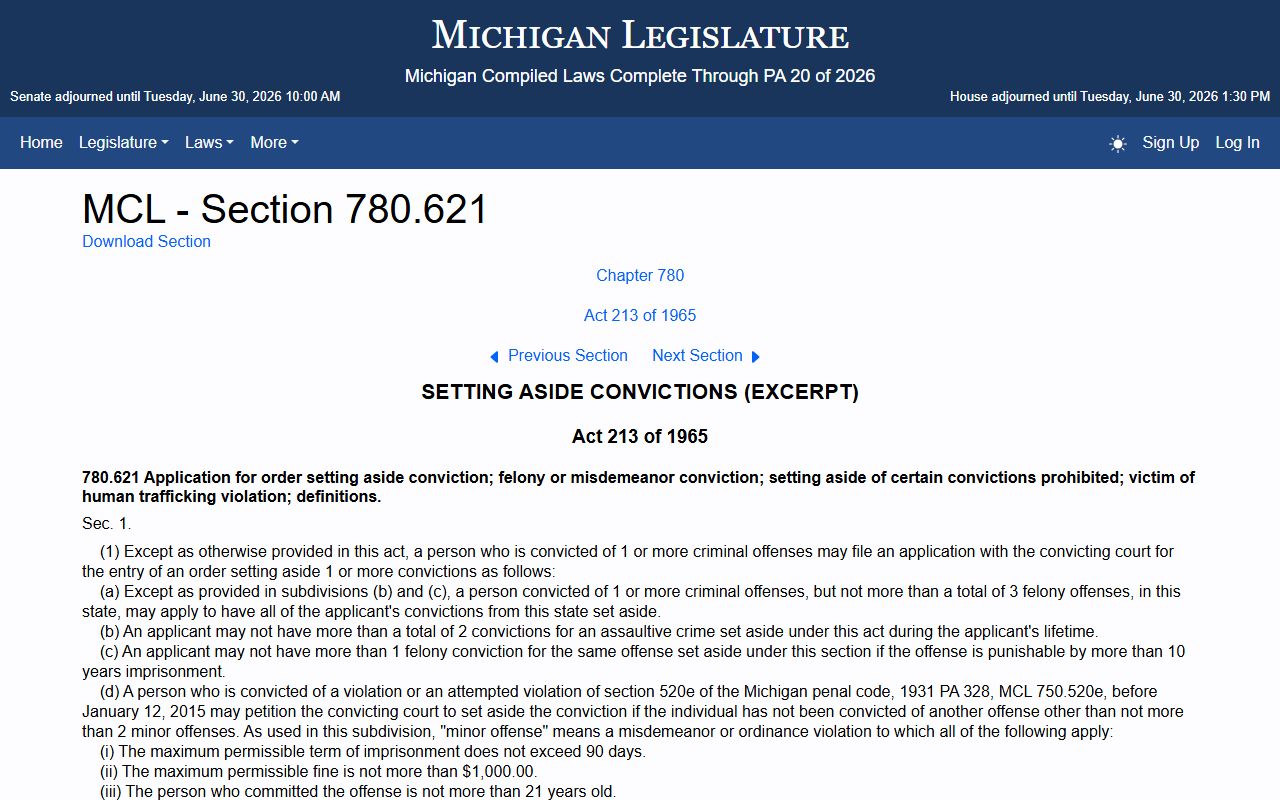
The statute lists waiting periods and offenses that cannot be set aside, so it drives whether a criminal court record stays public.
| Sealed | Expunged / Set-Aside | |
|---|---|---|
| Visibility | Hidden from public view | Removed from public criminal history |
| Record Still Exists | Yes, but restricted | Court file may remain; public access ends |
| Michigan Path | Court order in limited cases | Set-aside under MCL 780.621 or automatic Clean Slate |
Note: A set-aside can be reversed when restitution stays unpaid and the court finds no good-faith effort to pay, so cleared status is not always permanent.
Background Check Considerations
A casual online lookup is not the same as a background check under federal law. The Fair Credit Reporting Act governs reports used for jobs, housing, credit, or insurance. Records pulled for those purposes must come from a compliant source and follow strict rules. A general criminal court records search is fine for personal knowledge, but it is not a legal screening tool.
Important: Criminal court records pulled for a background check are not a consumer report under the Fair Credit Reporting Act, and they may not be used to decide employment, housing, credit, or insurance.
Restricted Criminal Court Records in Shiawassee County
Not every criminal matter is open to the public. Some Shiawassee County criminal court records are restricted by law. Juvenile cases are the clearest example. Under MCL 712A.28, juvenile court records are open only by court order. Sealed and set-aside convictions also leave public view.
Michigan's automatic clearance program is explained on the Michigan State Police Clean Slate page.
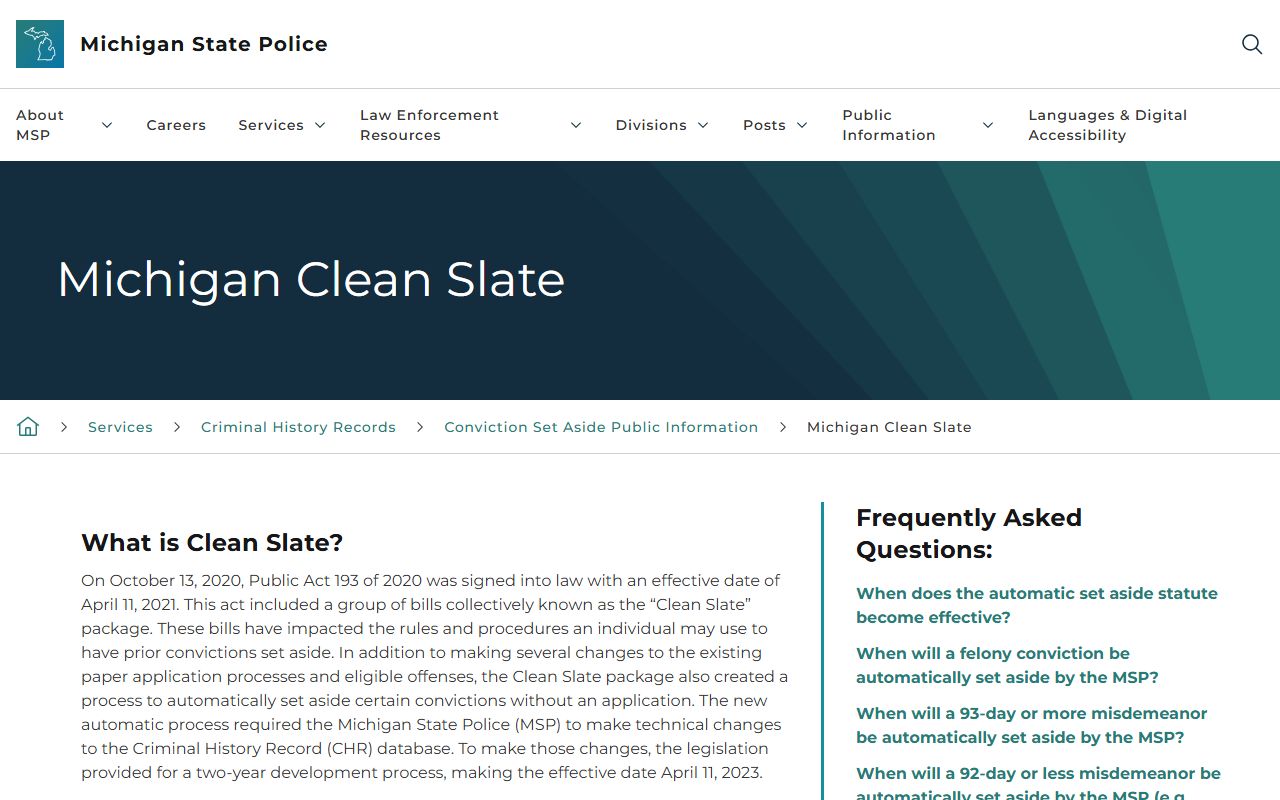
Clean Slate removes qualifying convictions from public criminal history, so a set-aside charge should not appear in a routine records search.
Other categories stay limited as well. Protected personal details became nonpublic under Michigan court rule changes. A criminal court records search will not show these items:
- Juvenile delinquency and child-protective files, open only by court order.
- Convictions set aside through Clean Slate or a granted application.
- Dates of birth, Social Security numbers, and other protected identifiers.
- Ongoing investigations and sealed search warrants before execution.